Monday, June 11, 2007

On fanaticism and hypocrisy


June 2

Left: Garbage thrown by settlers onto fencing over Hebron's old city market. This used to be the center of Hebron's consumer economy, now it's virtually a ghost town.

The only interesting case that came into the ER today was an old woman, probably in her late fifties or early sixties, who’d been kicked in the face by a donkey. I couldn’t help but chuckle at the relentless bad luck: you’re born in Palestine, you become a refugee in 1948, the Israelis come back to haunt you in 1967, you survive the First and Second Intifadas, you live your whole life as a peasant farmer, and then your damn donkey kicks you in the face so hard he breaks your maxillary bone and slices a three-inch-wide laceration into your cheek. There’s little respite for the Palestinians, and none for their poor. Ours is a life truly blessed.

More on the water I drink and bathe in at Musa’s house. Like I said before, it comes into the village on trucks at outlandish prices. But where does it come from? How does it get into those trucks in the first place?

“The situation is ridiculous,” says Musa. “It comes from Kiryat Arba. It’s illegal, even by the Israelis [i.e., under Israeli law], but they hire Palestinian lorries and they split the profit.” That’s Kiryat Arba, the settlement of perhaps the most hardcore Jewish religious fanatics in the West Bank, built right inside Hebron. These are the people who write “Arabs to the gas chambers” in graffiti in Hebron’s beautiful old city during Jewish holidays, when the Army shuts the whole city down so that these lunatics can go on their rampages unimpeded; the people who erected a shrine to Baruch Goldstein (who murdered 29 praying Palestinians at the Ibrihim Mosque on February 25, 1994, if I remember the date correctly; that year’s Purim festival). These people have such a dearth of shame that they will sell Arabs water they’ve stolen from them at 10-100 times the price they pay each other for it. They will allow Arab truck drivers into their settlement to pick up the profitable contraband for delivery but shoot Palestinian farmers who try to tend their olive groves and beat Palestinian children for the crime of walking to school (along with the international Christian Peacemakers Team members who accompany them). I don’t know how to describe such people without using Nazi analogies, so I won’t.

Note, again, that there is obviously no shortage of water here since the settlers are willing to sell it off. The issue for Israel is control of water in order to deny it to the Palestinians, not access for the settlers.

Musa also told me about a nearby collection of villages whose names I will now misspell: Yata, Diaya and Samour. Musa told me B’tselem wrote a report about their water situation, which is quite enlightening. About two-thirds of the houses in these villages have been cut from the water network, and so are in the same situation as Musa’s village; about one-third of the houses remain connected to the water network.

Those houses connected to the network get normally-priced water from the tap. How much do they get? On average, one day of running water every three months. One day out of ninety. Apartheid can’t get much clearer without putting up signs designating separate Jewish and Arab water fountains.

Why do these villages get such little water? Because the pipes to the village run through Kiryat Arba, and the settlers can turn the spigot off whenever they chose. Note the cruelty: they’re not denying children candy or roller coaster rides or even freedom itself, but the single thing they need most to remain alive.

I also asked Musa about something I saw when I was here two years ago. In Hebron’s old city there’s a beautiful open-air market with apartments above it. Settlers have occupied the apartments. When you walk through the market the first thing you notice is that someone seems to have ripped a wire fence out of the ground, laid it across the market so that it forms an artificial roof, and then someone dumped garbage on top of the fence. The picture above should explain things (it’s from last time I was here, I haven’t been to the old city this time).

When I saw this I assumed that settlers used to throw garbage on Palestinians shopping in the market, and since the army wouldn’t do anything about it the Palestinians got some fencing and put up this pathetic barrier. The truth is rather more interesting: the army itself put the fencing up to stop the settlers from throwing rocks at people shopping in the market. (In case you’re really going to ask, yes, there is a difference between children throwing stones at tanks, and armed colonists throwing stones and rocks at the unarmed natives while they’re buying bread.) When the fence went up, the settlers, clever people that they are, decided the fence would be a perfect sieve to throw sopping wet filth on top of. They were right.

Note the incredible racism of the situation. The army could treat the settlers like they treat the Palestinians and just shoot their children randomly until they stop throwing stones at the Palestinians; this is of course unthinkable, and would be a terrible crime. The army could very easily evict the settlers from the apartments, which they occupy illegally even under Israeli law. The army could arrest those people who threw rocks, which again, is illegal under Israeli law. The army could have cemented or barred the windows of the apartments, which they have the authority to do under the military regulations in force in the West Bank.

But instead the army chose to do the one thing I can think of that would stop the embarrassment to Israel of Palestinians being rushed to the hospital with gaping wounds in their head and then telling the TIPH people “I was in the market and a settler threw a stone at me from the apartment my family used to live in”, while still allowing the settlers to disrupt the market just as fully as they used to. Now the settlers can just throw rotten food and shit at the Palestinians, and that doesn’t land anyone near the lazy eyes of the media. (TIPH is the Temporary International Presence in Hebron, which monitors human rights violations in the city but then only makes secret reports to the observers’ respective countries; quite useless.)

When I got home Suhail was watching an Arab satellite TV channel that dubs old American cartoons in Arabic. The Jetsons was on. Something about the inane adventures of a buffoon in a nonexistent fantasy world seems appropriate to this place. The commercials are particularly ridiculous: they’re all aimed at getting people in the oil sheikdoms to buy cars or cruises or some other stupid thing. Meanwhile Palestinians can’t repair their roads or afford basic medical care.

Security interviews


June 1

Left: Ayham in the Fawwar barber-shop.

Marwa
and Ahmed are still here with Kareem. I went to get my hair cut in Fawwar Camp across the street today, it was interesting. On the way into the camp two Israeli soldiers stopped me and Ayham and started asking us questions: where I'm from, what I'm doing, etc. The same soldier is at the entrance to the camp every day when Ayham goes to school. I told him I’m an American of Indian origin at least five times, but he wouldn't listen to me until the other soldier started yelling at him. What exactly he said I don't know, but I kept hearing “American” and “Indian”, so I assume he was saying something along the lines of he told you where he's from already. It reminds me of my trip back to Haifa from Arafat’s burial (ask me if you don’t know what I’m talking about).

When I left the barbershop (a room with a mirror and a chair) the men at the store next door called me and Ayham back to talk to them. We went, I greeted the man who had called to us, and he took my arm and led me into the store. In the store a few young men including a policeman and an older math teacher at a school in Hebron were standing around; they asked me where I'm from, what I'm doing here, etc. There were four men total, all in their late twenties or early thirties except for the teacher, who was probably in his late-forties. It was all very polite, in typical Palestinian fashion they kept insisting that I eat: bananas, apples, fruit juice (Israeli-made), chocolate, salted sunflower seeds. They also kept giving me cigarettes. I got the impression that it was a Hamas interview as much as an investigation of a curiosity. I can’t say I blame them, Israel sends undercover agents all over the territories to assassinate people. It was disconcerting at first, but after ten minutes it was easy to talk about working at al-Ahli, studying in the US, how many brothers and sisters I have, etc.

Ayham wandered off, I’m not sure if he was told to leave or not. Eventually I said I should go back to Musa’s house and thanked them for their hospitality. Every one of them asked me to come eat at their homes; I said I’d be delighted to, but it was just a gesture, I probably won’t see them again and they probably figured as much.

Sunday, June 10, 2007

Two Small Stories From One Man's Life


May 31

Left: One of the trucks that brings water to Musa's village.

Today on the way into the hospital an Israeli soldier was standing alone about 100 yards from the front gate. Why I have no idea. I love the idea that Palestinians just want to kill Jews, yet this guy can stand in the middle of a city of 200,000 people without the slightest worry, not even holding his weapon.

Rusmaya told me about a story she’d seen on al-Jazeera last night about a young Palestinian refugee in Syria who had joined Fatah, then had moved to the PFLP, then moved to Fatah Islam (the group fighting the Lebanese Army in a refugee camp in northern Lebanon; it’s not a Palestinian group) and is now considering joining Hamas. It was interesting to see the progression societies can make in an individual: starting off with secular nationalist Fatah; when secular nationalist Fatah was co-opted by Israel and the US he turned to revolutionary Marxist PFLP; when revolutionary Marxist PFLP failed to accomplish anything he turned to Fatah Islam, which I assume is a radical Islamic organization. I wonder what will come up when radical Islam fails to effectively challenge US power.

I tried my first blood draw today. I got it, then lost it.

A middle-aged man was brought in after he complained of chest pains and then collapsed; he was unresponsive when he got to the ER. One of the doctors told me he was a successful businessman during the Oslo years, but when the Second Intifada started he lost his investments and had a nervous breakdown. He’d been to the ER several times since then, always with chest pains that had no discernable physical cause; the doctors were all pretty sure the pains and LOC were stress-related. One of the doctors wanted to make sure, so he took one of the anesthetic aerosol sprays and sprayed it directly into the patient’s nose. Sure enough, he shot up; then he started crying. It really must be awful to have invested so much of your time, money and life during the Oslo years in Palestine, sure that the Israelis were actually planning on leaving the West Bank, and then to have those hopes and dreams crushed by tanks, helicopter gunships and bulldozers. Americans break down when the wrong person wins a reality TV show.

The hospital fired one of the ER nurses today because she was working at al-Ahli and at Hebron’s government hospital, al-Alia. It’s apparently against al-Ahli’s rules to work at any other hospital because if they need people in an emergency they want them to be available. Still, most of the doctors said everyone at al-Ahli works at al-Alia as well because they need the money; they all said the administration was trying to scare the rest of the staff into quitting from al-Alia (which I’m sure pays much less than al-Ahli, when the PA can afford to pay anyone at all). Apparently hospital administrators can be just as stupid here as they can be in the states.

I had a very interesting conversation with Musa today about life in Hebron. The most important natural resource in the Middle East is of course water. At the beginning of the Second Intifada (almost seven years ago) the Israelis destroyed the pipes that brought water to Musa’s village (for security reasons; only terrorists use water). Ever since then he’s been without a guaranteed supply of running water. He had to build a large holding tank below his house so that water brought in by trucks at exorbitant costs can be stored (more on where the trucks get their water from later). Musa pays between 20 and 300 shekels (in winter and summer, respectively) for one cubic meter (1000 L) of water. That works out to 0.5 cents/L – 7.5 cents/L. According to Israel’s leading daily Haaretz, the average cost of water to an Israeli settler is 0.0625 cents/L. That’s a difference of between one and two orders of magnitude. Resource apartheid is an interesting concept. You might live a stone’s throw away from someone else of a different ethnic group, but they pay one one-hundredth of what you pay for a glass of water. Consequently they have green lawns and swimming pools, but you can’t flush toilet paper down the toilet because of the lack of pressure.

(In case you’re wondering “then how do they…”: there’s a plastic bag next to every toilet in Palestine. Only terrorists use toilet paper.)

Keep in mind that the West Bank is not a dry part of the world; it’s a temperate climate with several major aquifers, all of which are under Israeli control. Remember, only terrorists use water.

Musa also told me he was put in administrative detention twice during the First Intifada. If you don’t know, administrative detention is an Israeli euphemism for kidnapping: Palestinians are arrested and without charge or trial are put in Israeli prisons for up to six months at a time. The sentence is renewable indefinitely by a military court in which secret evidence is permissible (and is often the only evidence presented). Arwa was born in 1986 or 1987; that means Musa missed six months of her first four years of life because he was in an Israeli prison for the crime of existing.

The Israeli government insists administrative detention is only used to prevent a planned security offense by the imprisoned individual, but it’s well known that administrative detention is used as way of disrupting political, social and economic organization, as a tool to recruit Palestinian collaborators and as a way of forcing “wanted” Palestinians of turning themselves in (by kidnapping their relatives).

Musa’s case illustrates this perfectly: both administrative detention sentences were originally for six months, but a lawyer’s intervention reduced them both to three. If it was known by the authorities who authorized his detention that Musa was planning an attack of some kind and that the only way to stop him from carrying it out was to lock him up for six months without trial, then why would they have reduced his imprisonment to three months? It would defeat the purpose of arresting him in the first place, were that purpose to prevent violence and not to punish the population arbitrarily.

Also note the incredible passivity of the population. If I were Musa and someone stole six months of my life without my having committed the slightest offense I would figure out a way to kill that person. Instead Musa went to work for a human rights group based in the same society that violated his rights, and now he stands helplessly with a video camera while Israeli soldiers abuse his countrymen, colonize their land, demolish their houses and shoot their children.

It’s lucky for Israel that Jesus was born in the West Bank; I dare say no population has ever been as passive in the face of such a massive and all-encompassing assault by outsiders as the Palestinians have. Remember that the terrorist attacks from the territories started in 2001, more than fifty years after the 1948 ethnic cleansing of Palestine and more than thirty years after the apartheid regime of the occupation began. The only comparable examples of such passivity in the face of annihilation I can think of are the Tibetans’ response to China’s invasion and the European Jews acceptance of the Nazi genocide.

I wonder if the Chinese claim that Tibetans are terrorists bent on destroying China and throwing the Chinese into the Pacific, or if the Nazis claimed that Jews were dangerous because of their high birthrate. If they did, regardless of whatever crimes Tibetans and Jews may have committed against China and Germany, we would certainly crack up in ridicule.

"So cute", or "Out of Palestine, into Iraq"


May 30


Left: Kareem (sleeping) and Suhail

Abu Nidal gave me the standard “enjoy life” speech that every doctor gives every medical student he comes across (he’s a nurse, but everybody treats him like a doctor, as they should). It’s funny how much doctors in the US complain about how terrible their profession is, how they don’t make enough money, how they don’t have enough respect, etc. They should see doctors here: often not even enough money to own a car, having to endure the whims of an armed 18-year-old foreign soldier on their way to and from work, and having to deal with everyone else’s frustration at the situation in Palestine.

A very old woman came into the ER for a prescription gluteal injection. She was a sweet old lady, old as in her skin felt like brown paper. After Rusmaya (the nurse who reminds me of Cyra) gave her the injection she asked who I am; Rusmaya told her I’m a medical student from the US. The old lady grabbed my hand and started telling me (in Arabic, I understood only from gestures) that she has chest pains. Rusmaya started laughing and the lady smiled, realizing something was wrong, but she couldn’t figure out what. Eventually I had to pull out my standard “asaf, bhekeesh arabi” (“sorry, I don’t speak Arabic”). She started laughing too as I helped her off the table.

The world’s most adorable little girl, I’m quite sure, came into the ER today. Her father was of African origin (quite a few Palestinians are), I’m sure they’re descended from some ancient migratory workers or slaves. Regardless, I think they’re less religious on the whole than most Palestinians, so when he came in this little girl, probably five or six years old, was wearing a little denim miniskirt and a cutesy pink t-shirt. I guess I can’t accurately describe how precious she looked. Her father brought her in because she’d thrown up after falling and hitting her head; we were worried she might have an epidural hematoma, but she was fine.

Another small child, probably around one year old, came in with a very deep forehead laceration and a skull fracture with his dura mater visible. I’m actually not sure if the exposed dura was through the anterior fontanel or through an actual fracture, I can’t remember when the fontanels close. Regardless, the CT showed a small depressed skull fracture, but on x-ray the doctor said it didn’t look serious enough to warrant surgery. We sutured half the wound shut without anesthesia, then dermabonded the rest.

In the service from the hospital to duar al-Manara the guy had a little air freshener sign handing from his rear-view mirror that said “I (a heart) (a picture of a marijuana leaf)” and a plush red heart handing next to it that said “I (a heart) (a phone number I don’t remember)”. On the radio: someone discussing Islam.

Walking between the two taxis I take to get home I met a young man named Ali who just finished studying business and economics in Cairo. He was hanging out with his friend Faris at a store that Faris either works at or owns; Faris had studied with him in Cairo. Ali speaks English quite well. He’s an ambulance driver and has an uncle who lives in Austin, TX and is in the US Army, currently in Iraq. “Shhhhh…” he said, “don’t tell anyone about that.”

Musa's daughter Marwa (not to be confused with his other daughter Arwa or his oldest son Orwa) and her husband Ahmed came over for dinner with their one-month-old named Kareem. He's a beautiful little boy. There was a swirl of chaos around him as everyone tried to get a piece of him; Ayham especially is convinced that Kareem is a toy and gets righteously upset when people tell him to leave the baby alone. Kareem’s face and eyes are perpetually curious; his eyes are a deep black. His feet still have that smooth softness of newborn skin. His picture is above: pure sweetness.

Saturday, June 9, 2007

"I am responsible for my actions, not my cousin's or someone else's actions."


May 29

Left: Some of the doctors and nurses I work with in the al-Ahli emergency room. I won't name names, for obvious reasons.

Before I got there a three-year-old boy had been brought in after being hit by a car. I found him in the x-ray room, naked and bandaged up, crying a little.

His scalp had been peeled back off his left frontal and parietal bones, I think it's called scalp eversion. The damage to the skull was minimal, though, they found a very small fracture and no brain hemorrhage. The poor kid also broke both his legs at the distal fibula and one of his arms. I think by “road traffic accident” the doctor meant a car had run the kid over.

I helped one of the younger doctors suture twice today. I just cleaned the sutures and cut them when he told me to, but it was interesting. The first time was on a young kid, probably two or three with a small cut to his right forehead. I don’t know anything about which lacerations need suturing and which ones don’t, but it seemed to me too superficial to suture. Regardless, we put two stitches in it. The little guy was flailing around so hard that we often lost control of him. When we left his dad was comforting him. He said something to me and laughed a little. I figured he was saying he’s a strong little kid. It was a funny thing for a dad to be proud of in that setting.

The second time was on a middle-aged lady who’d fallen and somehow gashed her head open. It wasn’t bleeding much anymore but she was cut all the way to the bone. It’s interesting to see how much control we gain over ourselves; the little kid flails so hard he almost rips the stitches out of his own head, while the woman in just as much pain (maybe more, she needed quite a few stitches) lies calmly and grits her teeth when the needle goes in. She was continuously praying under her breath and muttering “yarabee”, I think it means “oh my God”, or the equivalent.

Another work accident came in, he narrowly avoided a complete disaster. The patient was a young male, probably in his late teens. He came in with abrasions to his left back that looked as if he’d fallen on concrete without a shirt on: not a desperate emergency but quite painful. The shirt he was wearing had been ripped almost completely off. He said he’d caught his shirt on some sort of mechanical twirling axe, which had swung him around, then ripped the shirt, and then he’d gone flying and landed on his back. Abu Nidal and I cleaned him off a little. Abu Nidal applied a silver ointment and sent the kid home, he said the best way to treat wounds like this is as though they were second-degree burns.

I also saw a bone set for the first time today. Another young kid came in, probably 15 or 16. I’m not sure what happened to him but his right arm was broken quite badly. The fracture wasn’t compound but (without telling me he was going to do this) the casting nurse (a big guy named Fawzi, see below) grabbed the kid’s wrist and twisted it around, sending the guy almost off the table before I got my hands on his shoulders. Fawzi looks at me and says “torsion”, then chuckled to himself as I jumped on the kid.

Fawzi is a tall heavyset nurse who loves to talk about anything that comes to his mind in the most vulgar way possible. After casting the kid’s radius he said “come, I invite you to my office to have coffee.” We went to his office and he proceeded to tell me his entire life’s story (he’s 51 years old): how he went to work in Saudi Arabia at a “military hospital” run by Whittaker Corporation (Saudi military hospitals are often run by American corporations, Whittaker in particular, like most of Saudi’s security infrastructure); how he met an Irish woman named Linda whom he married and then divorced; how he moved back to Hebron with their three kids; how he raised the kids for two years without a job or money; how he used to take care of his “needs” without a wife (use your imagination, he was explicit); how he met another woman whom he’s married to now and has had seven children with; how he came to be a nurse at al-Ahli; why he’s not religious; etc. This all took almost two hours, during which I just smiled and nodded for most of the time. It was interesting; the conversation wasn’t a waste by any measure. I just thought it was funny that this total stranger was telling me about all of these things totally unprompted and in a foreign language.

Dr. Ahmed, a young doctor working in the ER at al-Ahli, was asking me about how moving to the US works. He said he’s studying for the Step 1 and 2 exams and will travel to Chicago in a few months to take them both.

He said he wants more information about work visas, green cards, etc., and that he’d contacted the American consulate in Jerusalem for more information. They told him he’d need to come into the consulate to discuss applying for a work permit, they wouldn’t do it over the phone. So he applied for a permit, and “I was shocked,” he said, “that they told me no.” The justification was the usual one: security. Dr. Ahmed said he spoke to a border police captain when the permit was denied. He asked the captain why he couldn’t travel to the American consulate and what security threat he posed. The captain told Ahmed he can’t go because his cousin was once involved in a security violation (which can mean anything from exploding a bus and killing a dozen people to resisting physical assault by a settler).

Ahmed insisted to the captain that this is unfair, that he can’t possibly be held responsible for what his cousin does. “I am responsible for my actions,” he said to him, “not my cousin’s or someone else’s actions.” The captain said that was too bad, and this is the way the security procedures work.

Of course, Israeli settlers up to their necks in illegal weapons smuggling, illegal harassment of Palestinians (even under Israeli law), destruction of property, assaults on foreign nationals in Israel and the territories, human trafficking, kidnapping, political assassinations and murder of children are not only free to travel wherever they please, but they are also protected by the Israeli Army (when they aren’t serving in it) while they travel, while they illegally smuggle weapons and harass Palestinians and burn crops and assault human rights workers and enslave Eastern European women in the brothels of Tel Aviv and on and on.

Two systems of law for two people based on ethnoreligious identity and enforced by a single authority controlled entirely by one of the ethnoreligious groups: apartheid at its worst.

Malpractice

May 28

I helped take sutures out of little boy's head today, he had amazing green eyes. Unfortunately a scab had formed over the sutures. I think if the sutured laceration had been cleaned regularly it would have been fine, but it hadn’t been, so the sutures were matted under dried blood. I thought it would be easiest to clean the suture site with gauze and water, but the doctor said it’s better to remove the scab with a scalpel. We did so, but the edges hadn’t solidified yet and so the laceration bled a little and caused the boy a little bit of pain, but other than that he was fine. I’ve seen this kid every day I’ve been in the ER, both of his arms are broken and his face is badly banged up. He had two sutured lacerations, one just above his right eye and the other less than an inch above that. I’m curious what happened to him.

A man a little bit older than me came in with shrapnel in his right hand from a “firecracker accident”; he was missing all the fingertips on his left hand from an old wound. The wound itself wasn’t terrible but he'd gone to an outpatient clinic when it happened four days ago. All the outpatient GP did was wrap his hand in gauze and prescribe “a strong antibiotic”, which one I didn’t ask but it’s irrelevant. When we removed the gauze it was clear that nobody had even irrigated the wound, let alone removed the half-inch wide collection of foreign bodies in it (and, now, the necrotic tissue). The guy had to be schedule for surgery tomorrow morning.

Dr. Ahmed, the doctor who told me about being denied a permit to Jerusalem to see the American consulate, was really upset about this; he said malpractice is rampant at the outpatient clinics. I asked why a doctor wouldn’t have done this properly, since even I know what basically needs to be done to a wound with shrapnel in it. Ahmed said it’s just out of laziness. That’s shameful, doctors like that deserve a swift kick in the face. The guy could have lost his hand if he’d waited two weeks instead of four days to come to the hospital; now he could easily lose a good deal of function and sensation in his hand, either from the damage or from the now-necessary surgery.

Friday, June 1, 2007

Jehad Takatqa

May 27

I'm in the service to duar al-siha, one of the kids we put a cast on a few days ago is here on his dad's lap. I’m sure they’re going back to al-Ahli. He’s a very sweet little boy, he broke his arm somehow, nothing too serious.

Saw a patient with Cartigner's syndrome in the cardiology care unit (CCU) today. Other than that the ER was very slow. One kid came in with a clean cut just lateral to his left eye, we had to hold him down while one of the doctors put two stitches in it.

Saw Jehad Takatqa in the ICU, he’s the 15 or 16-year-old kid who was shot in the head by an Israeli soldier during a demonstration in his village. He wasn’t even participating in the demonstration, not that had he been the shooting would have been justified. He apparently just stuck his head out the window of his house to see what was happening after he got home from school, and a soldier shot him from about 100 meters away. They had a CT scan of his brain, there’s a whole path from his left occipital lobe to his left frontal lobe where the brain parenchyma is simply gone; the cavity looks to be filled with blood. I moved his head to the left and he had that reflex we learned about that comes with a loss of cortical inhibition of brain stem reflexes, so I assume that means his left internal capsule was destroyed by the bullet. But again, I don’t really know anything about anything…

On the way out of the ICU I met Jehad’s father, Abu Nidal (no relation to my supervising nurse). Musa told me his family is extremely poor, they all live in a two-room house in Beit Fajar, near Hebron (the family has seven children, if I remember correctly). I was with a resident at the hospital who speaks a little bit of English, he and I explained to Abu Nidal that I’m an American medical student visiting the hospital for six weeks. No reaction from him, just a smile and an “ahlan” (welcome). I can’t imagine he wanted to do anything but punch me in the face and scream “you paid for the bullet and the gun that blew my son’s brains out!”

Had another interesting conversation with Abu Nidal about the news and why he doesn't like to watch it. He said it’s always the same, just bloodshed and more bloodshed, so what’s the point of watching? It was an interesting thing for a Palestinian to say, someone who is basically unable to change the fundamentals that define his life, when Americans say the same thing all the time, yet we have the ability to change the fundamentals of Abu Nidal’s life (and our own), and quite easily.

When I got home I had a very interesting conversation with Musa and Afaf about Jehad. “The Israeli soldiers are child killers, really” Musa said. The human rights organizations and many journalists agree. Chris Hedges, former NY Times correspondent and a highly experienced conflict reporter, writes that he had seen children killed in Kosovo and elsewhere, but he’d never seen soldiers lure children into a trap and murder them for sport (I’m paraphrasing as closely as I can remember). Thomas Friedman wrote in the New York Times, in February or March 1996 (I think), that he watched a Palestinian demonstration during which children threw stones at armed soldiers, and then the unthreatened soldiers calmly shot the children (in typical fashion he went on to blame “Palestinian mothers” for letting their children throw stones at tanks, rendering them equally culpable with the Israeli soldiers who shot their children. What moral universe that makes sense in is anyone’s guess.). B’tselem, the Israeli information center for human rights in the Occupied Territories (the group Musa works for) writes that so many Palestinian children have been killed during the Second Intifada that whether or not Israeli soldiers intended to kill them has become irrelevant. Indeed, Israel has killed more Palestinian children during the Second Intifada (since October 2000) than all the Israeli civilians killed by Palestinians in the same time period. Amnesty International and Human Rights Watch agree very closely.

Anyway, the conversation started when I mentioned that I had seen Jehad in the ICU. Musa had described his injuries to me several days ago and I’d said I didn’t think he’d live; and that even if he did he’d almost certainly be seriously crippled when he woke up. Afaf asked me after dinner whether or not I thought he’d be okay, and I told her I didn’t think so (again, I’m still just a first year student, I don’t know a thing about a thing. I’m just giving my impression of whether or not someone who had a good part of their brain blown out of their head by a high-caliber assault rifle is likely to recover). Afaf became upset and mentioned another child who’d been shot in Fawwar Camp, named Islam. Musa told me how he died: it was during the height of the Intifada, when the kids at the camp’s UN school would get out of school and go to burn tires in protest. Islam’s family was extremely poor, so much so that every day Islam would stand at the Israeli checkpoints with a cart and move people’s bags across the checkpoint for a shekel (the Israelis didn’t allow cars to pass the checkpoint, so you had to get out, walk across with your stuff and then get in another taxi). He’d do this all day when he wasn’t in school.

For whatever reason the soldiers didn’t shoot the kids who were demonstrating, instead they decided to shoot this little boy while he was running bags back and forth for twenty cents. According to witnesses the soldier who shot Islam simply crouched into position from 20 meters away, lined the boy up in his site and blew his head off, not even an attempt to hide the murder of a child, not even feigning interest in his own humanity.

After Musa told me all of this he stared off into space for a moment, then said “I still remember this boy very well, I can never forget him. He would just go with people’s things, back and forth, he was so poor. The Israeli soldiers are child killers, really. Why to shoot this boy?” I asked Musa why he thinks the soldiers act this way, murdering a helpless and inoffensive child. He said he thinks its part of the culture of racism, the idea that all Palestinians are terrorists out to kill Jews, that they’re dangerous, that they’re living on Jewish land (“squatters for 2,000 years” as one early leader of the Zionist movement put it), etc. That seems plausible to me, people can’t shoot children without some sort of dehumanization of them beforehand.

I remember reading a book at Hopkins for Siba Grovogui’s class about a US soldier named Thompson, I think the book is called The Unsung Hero of My Lai (the famous My Lai massacre of Vietnamese during the Vietnam War). The first page of the book is someone talking to one of the soldiers who actively participated in the massacre. The interviewer asks “you shot women and children?” The soldier answers in the affirmative.

“And babies?” the interviewer continues.

“And babies”, the soldier replies.

Confused, the interviewer asks something along the lines of “I have to ask, how does someone with a wife and children shoot babies?”

The soldier responds “I dunno, it’s just one of them things.” I wonder if that soldier will tell his grandchildren he shot Islam for reasons he can’t even articulate.

Like many if not most Palestinian houses, Musa’s house is built into the side of a hill. At the base of the hill is an Israeli sniper tower and, on many days, a flying checkpoint, either in the morning or, more often, in the evening; the children who live across the street from Fawwar have to walk past the sniper tower to get to school every day. The tower is no more than a football field away from where Islam was murdered. I try to imagine myself in the tower looking down at these 10 to 14-year-old kids walking to school, shoving each other and playing in a language I can’t understand, then bringing a rifle up to my shoulder and splattering one of their brains onto the road. No kind of trauma bothers me in the slightest anymore; I haven’t gone vagovagal since Zimbabwe. Still, I can’t imagine doing this, and I certainly can’t imagine sitting around talking about doing it with my buddies, then doing it, and then going back to my friends and hearing them say “good job, you showed that one!”

To be fair, I can’t imagine paying someone to do these things, either. Yet we Americans do so, every day, and to the tune of some $11 million dollars to Israel alone, leave aside our own violence.

An Israeli soldier named Furer wrote a terrifying description of his time at the checkpoints, I don’t know the name in Hebrew but the English translation is Checkpoint Syndrome. Major Israeli bookstores refused to stock the book and the publisher refused to allow the book to be translated into English, so a media-monitoring group called If Americans Knew translated it and posted the translation on their website; it’s only two dozen or so pages, you can find it at http://www.ifamericansknew.org/download/checkpoint_syndrome.pdf. Furer, an art student who considered himself an especially sensitive person, writes about forcing Palestinians to sing Israeli songs “like a choir”; about fellow soldiers shooting children with weapons that blew their legs off (and subsequently falling into a state of psychological shock); about making Palestinian children clean the checkpoint for the soldiers; about throwing Palestinians’ IDs and permits into the air so they have to scrounge around on the ground to collect them (losing them would be a disaster); about beating, humiliating and photographing a Palestinian dwarf; about beating a wanted Palestinian until his face was covered in blood and then photographing him; about forcing elderly Palestinians to give them their prayer beads (expensive beads on a string used by Muslims to pray, often a prized possession) and then comparing his collection of stolen prayer beads with other soldiers’ collections; of breaking a young man’s hand and slashing his tires because he refused to give a soldier his cigarettes; of savagely beating a helpless, unarmed mentally retarded 16-year-old, kidnapping him and then letting younger soldiers abuse him at their base for fun; of beating a father in front of his family until he cried; of beating and urinating on a Palestinian because he cursed at one of the soldiers; of forcing a Palestinian to get on all fours and bark like a dog after beating him; of shooting someone for directing others in a stone-throwing demonstration; and more. All of this was from 1996-1999, the “quiet years” of the Oslo Accords.

Not much seems to change when human nature and absolute power come together.

Just like someone else I know...

May 26

Today one of the young female nurses took me under her wing and showed me how to do ECGs and how to insert canuli. Some of her friends came by and kept giggling about me, what exactly they were saying I don't know but they kept saying my name and then asking her where I’m from, why I’m at al-Ahli, etc., then laughing and looking at me. I'd look up at them and smile and they'd look away quickly and giggle more, but the nurse wouldn't, she'd just smile. She reminds me of no one more than Cyra, they look nothing alike but their personalities are very similar. It's interesting to see people dressed so differently and speaking such a different language and then realize how superficial the differences are.

Dr. Harb explained to me that he had an exam in medical school called topography (he went to school in Romania) where they had to orally describe the anatomy of a section of the body. He said you would start with the bony structures that give the region its overall shape and then go on to the muscles, nerves, etc. The only parts of the body that don't have a bony support are the abdomen and the penis. When one of his classmates was called to give her topography exam she was given the penis, and so thought for a minute about the bony structures. Eventually the doctor told her “there's no bony support for the penis. I know it feels like there is, but there isn't.” Harb thought this was absolutely hilarious. Again, not the kind of thing you expect to hear from Islamic fanatics...

Today is Saturday so Musa is off work. When I came home a man was here with his wife, Adil and Maya. He's Palestinian and she's a Canadian Israeli Jew. They're married and have a kid on the way, Nour (light), but they can't live together because of an Israeli law that doesn't recognize Palestinians from the territories who marry Jews as candidates for Israeli citizenship. They're leaving in a year to go to Canada (“inshalla”, or "God willing", as Adil says). Maya used to work for B'tselem so this must piss her off. They met when he worked at a restaurant in Jerusalem and she was working for B’tselem. She understands a bit of Arabic but he speaks Hebrew fluently. Their kids will be trilingual from the start and ridiculously good looking.

Maya lived in Toronto for eight years and speaks perfect Canadian English (including the annoying way they say “know”). She studied archaeology and world religions at U of T; she said she hated it. She was particularly incensed that in her linguistics classes there were zero mentions of Chomskian linguistics. I felt like it was a test of my credentials, or maybe my level of knowledge, to see how I’d respond. I've had the same experience with multiple Israeli peaceniks. I always think it's amusing since the first serious piece of work I ever read on the Middle East was Chomsky's Fateful Triangle, first published in 1983 and still well worth reading today.

Later on we were sitting around watching al-Jazeera (they keep showing a short clip of the NBA finals but I can't tell what's going on...did the Pistons win or lose?). Suhail was bored and so took his dad’s lighter and started setting small pieces of cardboard on fire in the middle of the living room. I braced myself for the worst kind of motherly reaction: it’s the kind of thing American parents would fly off the handle about. Musa and Afaf were sitting next to each other and it didn’t phase them in the slightest. American kids would know, too, that their parents would be pissed about lighting things on fire, especially in the living room, so they would hide it from their parents. But Suhail goes “baba shouf! Shouf!!” (“dad look!” *no response* “Look!!”). “Shway shway” (“be careful”) said Musa, unconcerned. Suhail once again proved how cute he is. He reminds me exactly of how I thought Zubin Shetty would act when he turned 11 years old.

Wednesday, May 30, 2007

"al-Qaida" in fractions


May 24


Left: Musa and Suhail studying for Suhail's math test.

The first case that came into the ER was a deep slice out of someone's foot, he was in his late teens or early twenties and worked as a stone cutter. Some machine destroyed his right foot, broke a section out of the second and third metatarsals, which were exposed, and seemed to have damaged the extensor digitorum longus tendon (do I remember the anatomy correctly?) but didn't sever it. I'm sure he went straight to surgery. He was hysterical even after analgesics. I wish I had a picture of it, it was one of the craziest injuries I’ve seen yet.

Another interesting case was an old woman with pancreatic cancer of some kind. She'd had it untreated for two years, one of the doctors said the normal prognosis even with treatment is six months. She was very old, I’m sure she was over 90, but the family said they wanted her resuscitated no matter what, so they ran CPR on her for a while, but it was hopeless. It took ten minutes just to find a vein that would take a needle of any size. It was the first time I’ve watched someone die. It wasn’t as personally eventful as I thought it would be and as other people had made it out to be.

At home Suhail was studying with Musa for tomorrow’s math test. They were studying fractions and Musa kept saying “al-Qaida” over and over again. I couldn't figure out why, but then I remembered that al-Qaida means “base”, so I’m sure it also means “denominator” or something along those lines. A culture clash waiting to happen…

But why to destroy these beautiful towers?

May 23

Yesterday, May 22, was my first day at al-Ahli, it was pretty chill. Today, May 23, was busier. I spent most of the day with a doctor named Harb (“war” in English, reminds me of Head Nurse Gawfe in Zimbabwe; Gawfe means “death” in his language) who was very good. He left at three, so I left at the same time, got the service to duar al-manara (Manara circle, part of Hebron), walked around until I found a pack of Gauloises Blondes and a lighter (five shekels), then found the service (pronounce “ser-veese”) to Fawwar Camp. This time I didn't get lost walking home like I did yesterday.

In the hospital I saw quite a few different cases: kid with a fractured nasal bone; kids with all sorts of facial lacerations; COPD in an old heavy-smoking man; car accident victim with broken cervical spinal column; a baby with congenital hydrocephalus and a hugely enlarged left lateral ventricle (she had a shunt installed in Jordan when she was born, nobody in the ER was sure what was causing the hydrocephalus since the shunt was still in place); kid with a fractured skull and likely epidural hematoma; vertigo caused by otitis media; all sorts of other fractures in kids (greenstick, tibia, wrist, skull), and more.

Had an interesting conversation with Abu Nidal, the nurse I spend much of the day with, about the world situation. Best line, “I am against America, totally, but why to destroy these beautiful towers, made by the human mind? Yani, it’s crazy.” (“Yani” is an expression that means “uh”, “I mean”, “you know”, “fuck off” and anything else you want it to.)

Musa was planning on having people over for a barbecue but the brother-in-law of the people who were coming died suddenly from a heart attack (35-years-old), so they didn't come and we ate a normal dinner. Afaf has been very upset since she found out that this person died, she keeps apologizing every time she flies off the handle at Musa or someone else on the phone.

I played volleyball with those kids again, they love playing with that torn-up ball on their construction site-turned volleyball court between throwing rocks at their goats to stop them from getting too far away. (Picture coming soon...)

(Side note: I think Palestinian kids are prone to throwing rocks at the IDF because they do so all day to keep their goats where they want them, so it’s a natural thing for them to think of.)

Just figured out why Afaf is so upset: her oldest daughter's husband is his mother's oldest son, and so became jealous of Afaf’s daughter when they married (a common problem in Arab culture according to Musa). They have an adorable baby, Kareem, and the grandmother takes him away and tries to care for him instead of letting Afaf’s daughter be his mom. That angers Afaf’s daughter, so her mom gets upset, too.

Tuesday, May 29, 2007


May 21

Left: Ayham (left) and Suhail

I got my computer out to transfer these diary entries over to it from my phone. Suhail and Ayham were back from school, so I let them play with it for a while, I thought they'd just use it for ten minutes. They've been on it for hours now even though they have their own computer, they're playing all of their pirated games and watched some stupid movie called Cellular, also pirated. I think they're just bored.

One funny thing: they started playing Hearts. They'd obviously seen it before, they're familiar with the idea of passing cards, etc. But they think the goal of the game is to get the highest score possible, so they keep playing exactly the wrong way and then cheering because they think they're troucing everyone else. Very cute.

We ate dinner, Musa's wife Afaf is an excellent cook. I keep forgetting not to eat with my left hand; I can’t tell if they think that’s weird. Afterwards we smoked Musa's argila (sheesha/hookah) outside. Musa got a call from B’tselem while we were smoking: someone was being held at a checkpoint near Jerusalem and had been there for three hours, apparently because he asked the soldiers why they were ripping the seats out of his car.

Lag time...


Left: me at Heathrow.


I've been keeping a regular diary here, but unfortunately I haven't been uploading it to the web. So, for the next eight days I'll update two days at a time, hopefully that way if anybody is actually reading this they won't be overwhelmed with ten pages of information about emergency medicine...

May 20

Landed at 5:30 am, still sitting in the security holding area at 8:15. Only guy I talked to was a British Arab here on business, said he was held here for six hours the first time he came to Israel. When I first got here there were two guys waiting, both Arabs in their mid 30s. After a while a very frightened looking white kid came in. He's gone now. A family of African immigrants came in with some very cute kids, I think they were Ethiopian immigrants. They stayed a little bit less than an hour. Then a black man with a huge suitcase came in, some police questioned him about it and then he left with them. A British lady also came in, said her husband was going to be in Israel for a long time for something and then told the security lady she didn’t want to have to wait for two hours each time she comes to visit him. I’m almost positive one of the ladies who interviewed (interrogated?) me at the airport is the same one who jumped at me as soon as I got off the plane in 2004. At least this time they didn’t stop the airplane on the tarmac and interrogate me on a dark airstrip with nobody around.

I first went to the customs people after talking to a nice Jewish lawyer, I think his name was Darin, who was visiting friends in Tel Aviv. The customs lady took longer to process me than it took the guy next to her to process three people. Then she told me to wait, then a security guard came and put me in some kind of holding area, where I am as I write this. A thin tall lady with glasses came and took me into a bare office, the only things on the wall were a picture of an Israeli airplane flying over the Haram al-Sharif/Temple Mount and an Israeli flag. She said she was going to ask me some security questions, which she did, then she told me to go back to the holding area. Just then another woman came, healthier looking, and asked me most of the same questions over. This is the lady whom I’m sure is the same one who questioned me when I first came to Israel in 2004. Then I came back out to the holding area, then the healthier looking lady came and asked me all the same questions again. Then she said she'd go finish the security procedure, then a guy came with an ear piece connected to something on his back and asked me the purpose of my trip. I told him I’m volunteering at a hospital in Hebron, then he left. Now it’s 8:30 am, been here three hours and counting..

Got out at 9:45 from the security holding area. Then walked about 90 feet to get my bags and was stopped again. Three people, one woman and two men walked me to find my bags. We took them to a basically unmarked room, so before going in I insisted they tell me where we were going. They pretended not to speak English (I’m sure they were BSing, every single person I spoke to at Ben-Gurion Airport spoke English perfectly well) so I followed them without an answer. The room was for x-raying and inspecting bags. The three people (one of the men left, and we were joined by another woman in the x-ray room) turned out to be very interested in my shaving cream for some reason. There was a coffee machine in the holding area of the x-ray room, never a good sign. Finally I left after about 15 minutes of bag-finding and 45 minutes of x-raying (two bags and a laptop, the famed Israeli efficiency somehow lacking).

Got a sherut (a shared taxi) to Jerusalem, sat next to a girl and her girlfriend. The girl told me she leads volunteer trips to the Galilee to revamp old Israeli bomb shelters. She grew up in Jerusalem but her mother is from the US or Canada (she kept saying she’s from “North America”, I’m not sure why) so she spoke English perfectly well. She asked what I’m doing in Israel and I told her, she expressed her support and told me I should visit “the great Jewish community in Hebron.” Then she asked me what I think of the conflict, I told her I think it's primarily the fault of the United States at this point. She first told me that she doesn't know a thing about history, agreed that the conflict is the US fault, but dismissed any idea that Israel could ever have peace because, at various points in the conversation, “Israelis have a fire in them”, Egypt's 1971 peace offer was “bullshit” (she straightforwardly stated she hadn’t a clue of anything that had happened in 1971 anywhere, but insisted that the offer she knows nothing about wasn’t serious), and some other nonsense. My favorite point in the conversation was when she said “I don't know about history but I know that's false, because after Israel uprooted Jews from their homes in Gaza, where they'd buried their children, Israel didn't get peace” and then “the Camp David offer was for 98% of Israel[sic!]”, etc. She explained away the occupation by pointing out that “Jewish communities [her euphemism for the Jewish-only colonies in the West Bank, the settlements] have a wall around them and patrols because people want to shoot them, but the Palestinians don't have any of that, they live in complete security.” (Note the sheer lunacy of that statement.) She also explained that “the IDF is an exclusively defensive force: it's called the Israel Defense Force”, and that “Israel would only invaded Lebanon to stop rocket attacks, if our government is honest.” I asked if she thinks that the current scandal-a-week government of Israel is honest, and she said “absolutely not.”

Then some fat American Christian turned to us and started quoting the Bible. I have no patience with these people, who happily march Jews and Arabs into hell in the Middle East so they can meet their Mesiah, they're despicable. I told him I wasn't interested in what the Bible says, but he wouldn’t shut up (the Israeli girl I can at least talk to, but I’m not going to debate Biblical nonsense with some idiot who thinks everything he says is profound because it comes from God Himself). He told me that “Newton didn't invent gravity, he just discovered it, and we just don't understand the spiritual principles that guide the universe” and which will do something in the future, what he never specified. He went on to explain that “there are four branches of the American government”, the State Department being the fourth, and since it's so anti-Israel that has something to do with the American-Israeli decision to co-opt the PLO in the Oslo accords, with Arafat stealing money, etc. I tried to explain that the cooption of the PLO was part of an American-Israeli plan to break the Palestinian national movement and the Intifada, it wasn’t some anti-Israel conspiracy conjured up by Arabists at the State Department, but he just blinked a few times and that information was dispatched to the memory hole. Thankfully at this point that guy got off the sherut. I changed the subject with the girl and we spent the rest of the ride talking about where to drink in Jerusalem.

I got to Hebron without much of a problem. Went to the Palestine Agricultural Relief Committee office where Musa's wife Afaf works. Talked to the director for a while, he helped me remember a lot of the Arabic alphabet, then went to the dentist for Afaf and then to Musa's house.

Musa seems well off; he used to live in the nearby refugee camp (Fawwar) but now has a floor of a house for his family. It’s a little bit bigger than my two-bedroom apartment at the Vintage in San Antonio (but, of course, Musa has five kids). Two of his kids still live here, they're 11 (Suhail) and 13 (Ayham), both adorable boys.

Friday, May 18, 2007

First Post

My name is Feroze Sidhwa; I'm a medical student at the University of Texas Health Science Center in San Antonio. Tomorrow I'll fly to London and then on to Tel Aviv, Israel, and from there I'll travel to Hebron (Khalil in Arabic) in the occupied West Bank. There I'll volunteer at al-Ahli Hospital for about six weeks, then fly back to start my second year of medical school.

Internet access permitting, I'll keep this blog updated with my observations of what happens in Hebron, in al-Ahli and in any other parts of the West Bank I can visit while I'm there. I've never blogged before, so I'm not exactly sure how it works, but if pictures can be posted then I'll post my own photographs whenever possible.

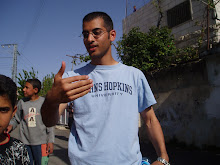
About me: I'm a 25-year-old American born in Houston, TX and raised in Flint, MI. I graduated from Johns Hopkins University in 2004 with a B.A. in public health and a strong focus on political science. After Hopkins I traveled to Israel and worked with a Palestinian NGO based in Haifa for eight months. When I returned to the United States I worked as an eighth-grade science teacher for the Baltimore City Public School System at Thurgood Marshall Middle School in Baltimore, MD. While teaching I applied to medical school, got into UTHSCSA in San Antonio, and in May 2007 I finished my first year there.

I’ve been educating myself about the Arab-Israeli conflict since my freshman year of college, when the second Palestinian revolt against the Israeli occupation broke out. Depending on how things go I might interject a bit of Arab-Israeli history into my blog; obviously I won’t have any history books with me in Hebron so, if I make minor mistakes vis-à-vis names, dates, etc., please forgive me.

Although it’s irrelevant, I’ll say that I endorse the international consensus on a two-state solution to the Israeli-Palestinian conflict: full peace in exchange for full withdrawal from the territories Israel occupied in the June War in accordance with international law, especially UN Security Council resolution 242.

Hopefully this blog can bring some everyday events under Israeli occupation to American readers, the only people who could end this conflict tomorrow, were we willing to do so.